The San Diego Harbor Cruise Route, Landmark by Landmark
The bay loop is two different trips sold under one name. Here is what each one covers, in the order it passes, and which rail you want to be standing at.
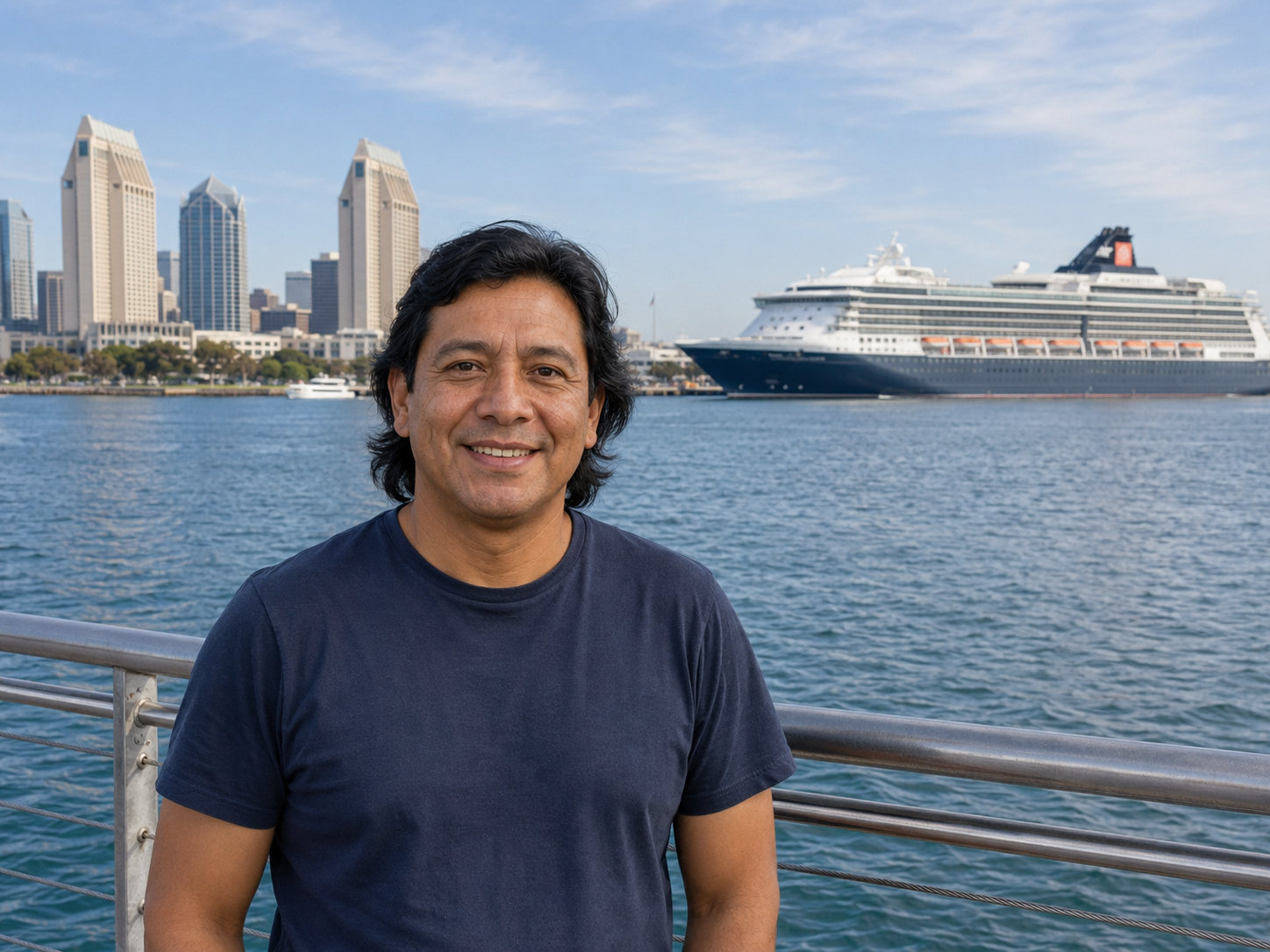 By David Ramirez, San Diego Bay cruise specialist & harbor experience guide
Short answer
The one-hour north bay leg covers the Embarcadero: the Star of India and the Maritime Museum fleet, the USS Midway, the downtown skyline and the sea lions on the channel buoys. The two-hour loop adds the south bay, the Coronado Bridge, the Coronado shoreline and the working shipyards. Both leave from Broadway Pier at 990 N Harbor Drive.
Ask ten visitors what they remember from the bay loop and half of them will say the sea lions, not the aircraft carrier. That still surprises me. The USS Midway is the reason most people book, and it does own the first stretch of the north leg, but the moment that sticks is usually a sea lion asleep on a channel buoy with a gull standing on his back. I have been putting visitors on these boats since 2015, and the route is the part almost nobody researches before they buy. They choose a departure time, they choose a length, then they find out on board that the one-hour and the two-hour trips are not the same trip at different speeds. They are different geography.
So this is the water, in order, with the side of the boat that matters and the moments worth having a camera ready for.
Which harbor cruise route should you book, the one hour or the two?
Take the one-hour north bay leg if you want the historic ships, the carrier and the downtown skyline in a tight package. Take the two-hour full loop if you also want the Coronado Bridge, the Coronado shoreline and the working waterfront south of it. The long version is not twice the trip, but it is twice the map.
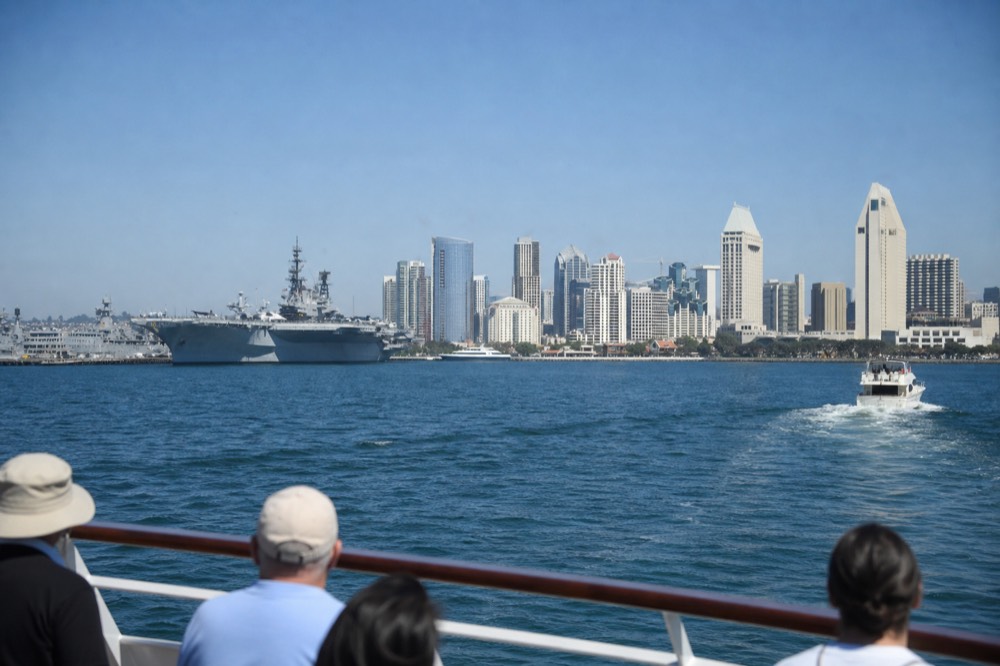
The classic loop out of Broadway Pier sells in one-hour and two-hour options with morning and afternoon departures, and the two hours are not padding. The bay is long. The north half is compact, historic and photogenic, and you can see most of it from the water in under sixty minutes. The south half is bigger, emptier and more industrial, and it takes time to get down there and back. The two-hour ticket buys the trip under the bridge and along Coronado, which is the part that most people describe afterwards as the part they did not expect to like.
Here is the honest split.
| Route option | Runs about | What it covers | Best for | The catch |
|---|---|---|---|---|
| One-hour north bay | 60 minutes | Maritime Museum fleet, Star of India, USS Midway, county building, Seaport Village shoreline, skyline, channel-buoy sea lions | First-timers, families with young kids, anyone with a Midway ticket the same day | You never reach the Coronado Bridge |
| One-hour south bay | 60 minutes | Coronado Bridge, Coronado shoreline, shipyards and the working fleet, open water toward Point Loma | Repeat visitors, bridge and ship photographers | Skips the historic ships and the Midway approach |
| Two-hour full loop | 120 minutes | Both legs in one sailing, north first on most departures | Anyone with the time, anyone on a single day in San Diego | Two hours is a long stretch for a restless toddler |
Ratings hold up on the long version: 4.5 stars across 3,262 traveller reviews on the live listing, with free cancellation up to 24 hours before departure, which is the part that matters when you are booking a week ahead against a forecast you cannot read yet. Harbor sightseeing starts from about $37 on current operator pricing, and the two-hour ticket costs more than the one-hour, so the real question is whether the south bay is worth the upgrade to you. If you have never been on the bay before, it usually is.
If the full loop is the one you want, it sits in the harbor cruise lineup next to the shorter run. Before you commit to either length, check the live price and availability for your date on the operator's official listing, because departure times shift with the season and the one-hour and two-hour options are priced separately.
What does the north bay leg actually show you?
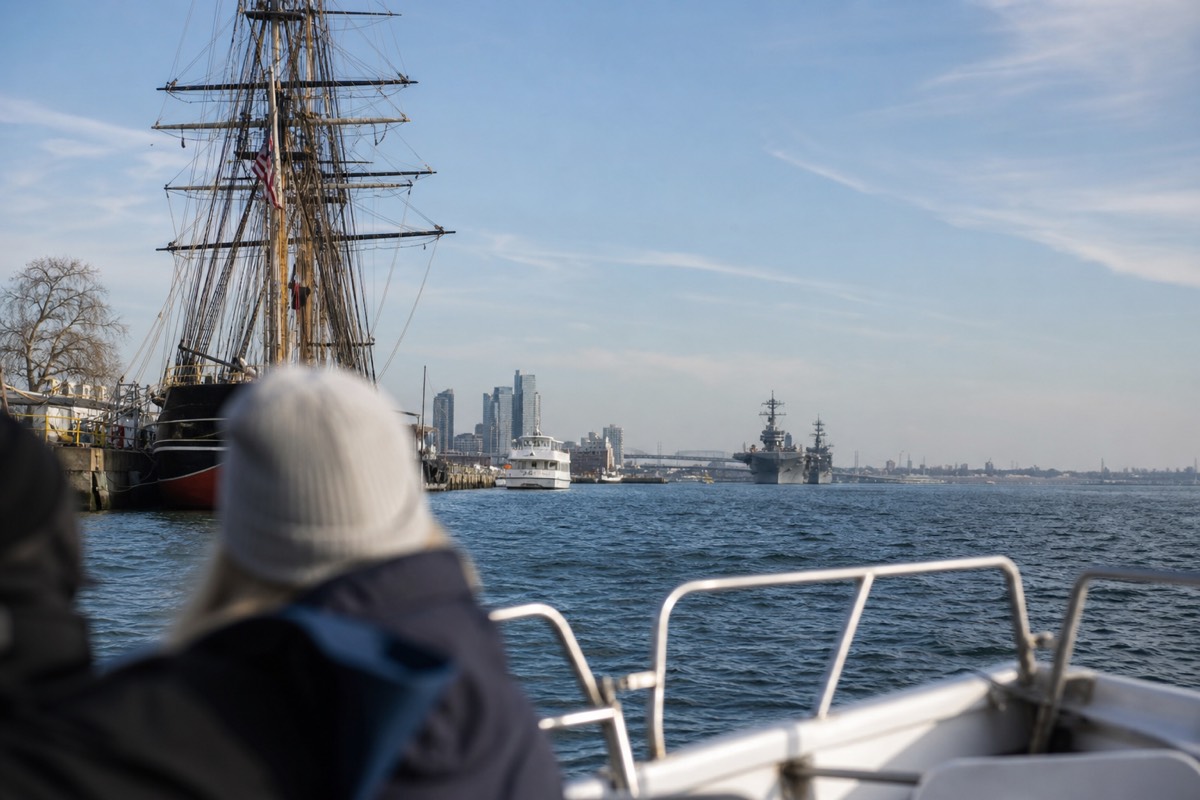
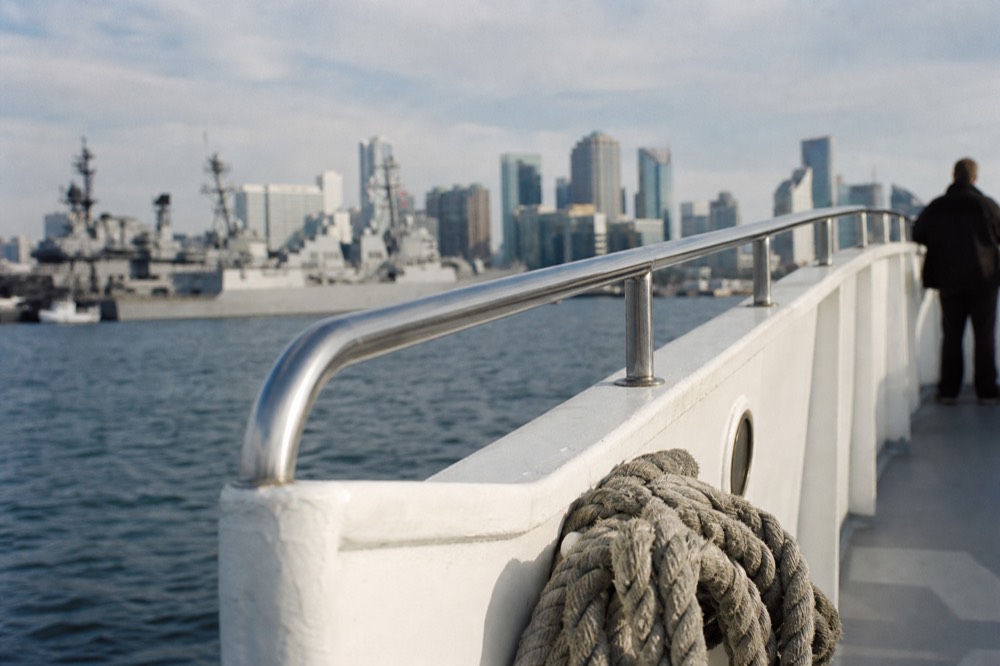
The north leg follows the Embarcadero shoreline: the Star of India and the rest of the Maritime Museum fleet, the USS Midway alongside Navy Pier, the county building, the Seaport Village waterfront and the downtown skyline stacked behind all of it. It is the postcard half of the bay, and every historic hull on the water is on this leg.
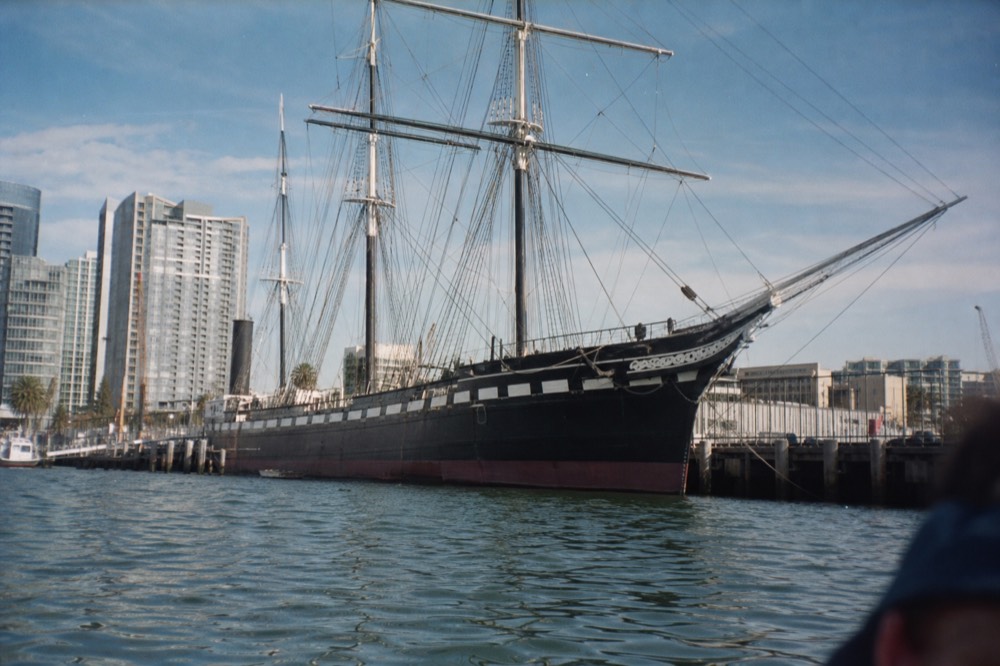
The boat clears Broadway Pier and almost immediately you are looking at masts. The Maritime Museum keeps its fleet along that stretch of the Embarcadero, and the Star of India is the one people recognise from the water even if they cannot name her: black hull, three masts, yards crossed, sitting lower and older than everything around her. From the deck you get her broadside, which is a view you cannot buy from the sidewalk.
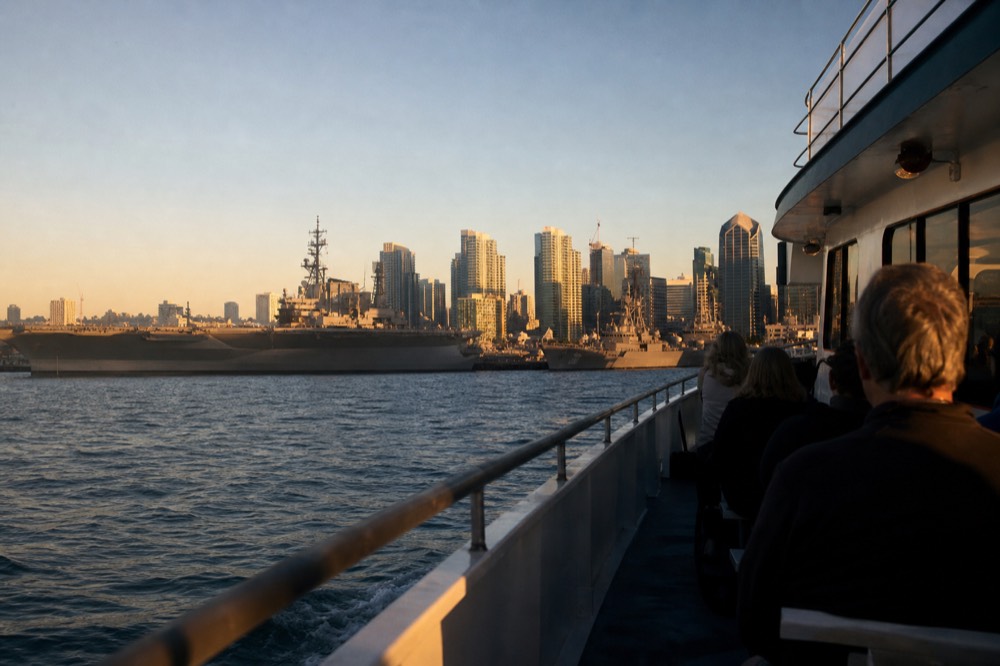
Then the carrier. The USS Midway is a museum ship now, and passing her at water level does something the shoreside view does not: you finally get the scale. From the promenade she reads as a wall. From a boat two hundred feet off her beam she reads as a ship, and you can see the flight deck overhang, the island and the aircraft parked on top in one frame.
After the carrier the shoreline turns into the city. The county administration building, the green strip in front of it, the Seaport Village waterfront and the towers behind. On a clear morning this is the strongest light of the day on the skyline, because the sun is behind the boat and the buildings face you.
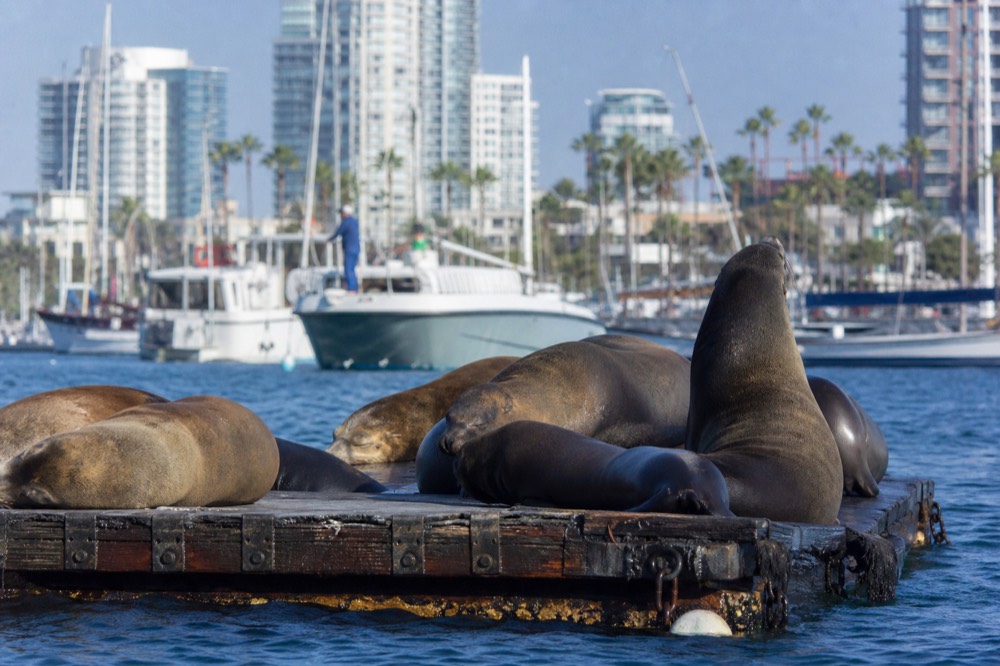
The sea lions are the wildcard. They haul out on channel buoys and navigation markers rather than on a fixed rock, so no captain can promise them, but the buoys in this half of the bay are where they most often turn up. Look for the yellow-white streaks on the metal before you look for the animal.
What is south of the Coronado Bridge on the long loop?
The south leg is the working bay: the Coronado Bridge from directly underneath, the Coronado shoreline, commercial shipyards with vessels in dry dock, and grey Navy hulls tied up along the piers. The horizon opens out toward Point Loma and Cabrillo. It is less pretty than the north half and more interesting.
The bridge is the reason to take this leg. From the road it is a commute. From the water it is a curved concrete ribbon two hundred feet over your head, and the boat passes under it, which is when everybody on the upper deck stands up at once. Wide lens, look straight up, and take the shot before you are underneath rather than while you are.
Past the bridge the bay turns industrial in the best sense. The shipyards run repairs on hulls big enough to have their own postcodes, and if a ship is in dry dock you get to see the part of a vessel that is normally underwater. The naval waterfront runs along here too, and the fleet you see is whatever happens to be alongside that week. No two sailings are identical, which is why locals who have done the loop three times still watch this stretch.
There is one honest warning. The south leg has long transits where nothing much passes, and the narration works harder than the view does. Restless children notice. If your group has a short fuse, the one-hour north bay leg is the better ticket, or the jet boat option at thirty minutes of noise and spray, which no child has ever found boring.
Landmark by landmark, what passes and in what order?
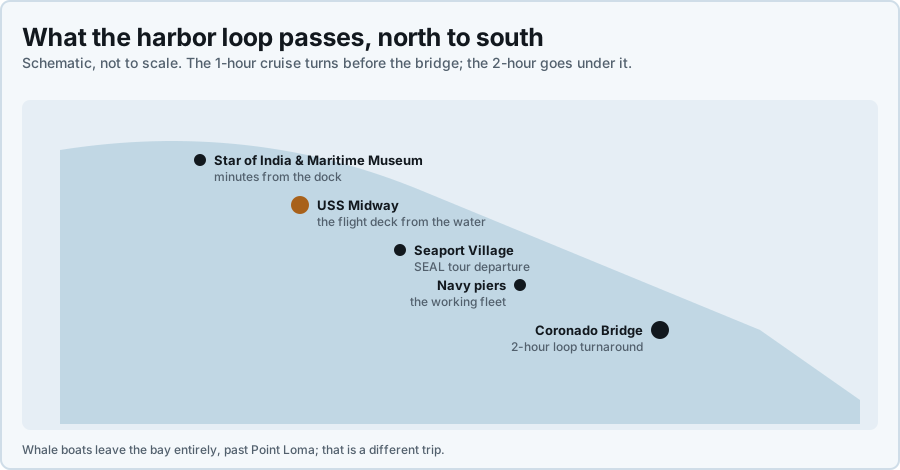
On a standard two-hour sailing the order runs north first: the Maritime Museum fleet, the Midway, the county building and Seaport Village, then south under the Coronado Bridge to the shipyards and the Coronado shoreline, then back. Departures vary, so ask the crew at boarding which way they are running today.
Direction is the one thing you cannot assume. Traffic on the bay, wind and the departure schedule all move the running order, and a boat that runs south first flips every "which side" answer below. Thirty seconds with a crew member at the gangway saves you an hour of standing at the wrong rail.
| Landmark | Which leg | What to look for | Camera note |
|---|---|---|---|
| Maritime Museum fleet | North | Masts and yards against the skyline, the museum's collection tied up in a row | Broadside as you pass, not head-on |
| Star of India | North | Black iron hull, three masts, visibly older than her neighbours | Shoot early, she is close to the pier |
| USS Midway | North | Flight deck overhang, island, parked aircraft | Wide lens, from the beam, sun behind you |
| Navy Pier and the working fleet | North to mid-bay | Whatever grey hulls are alongside that week | Long lens if you want detail on the ships |
| County Administration Building | North | Pale tower with the green lawn in front | Best in morning light |
| Seaport Village waterfront | North | Low roofs, the boardwalk, boats moored inshore | Good foreground for the skyline behind |
| Channel buoys and sea lions | Both legs | Streaked metal first, then the animal | Zoom, and be quick, the boat does not stop |
| Coronado Bridge | South | The curve, the height, the underside | Shoot before you pass under, then straight up |
| Shipyards and dry docks | South | Hulls out of the water, cranes, repair berths | Midday is fine here, the light is less critical |
| Coronado shoreline | South | Low buildings, beach strip, boats at anchor | Backlit in the afternoon, expect flare |
| Point Loma and the Cabrillo headland | South and open water | The high green ridge closing the bay's mouth | Horizon shot, keep it level |
Where should you sit, and which rail gives you the photographs?
Stand rather than sit, and use the open upper deck. Take the outboard rail on the way out and cross to the other side on the way back, since the boat retraces most of the route and the landmarks change sides. If you can only hold one spot, take the rail nearest the shoreline the boat is following.
The vessel is a large sightseeing boat with open decks, so nobody has to choose between a view and a seat for the whole sailing. The seats are for the transits. The rail is for the landmarks, and the landmarks come in clusters with quiet stretches between them, which is exactly when everyone else sits down and you get a clear rail.
Sun position beats seat position every time. Morning sailings put the sun behind you as you look at the downtown skyline, which is the single biggest photographic advantage on the whole route. Afternoon sailings reverse it: the city goes into haze and backlight, and Coronado and the bridge get the good light instead. Neither is wrong. They are different pictures, and knowing which one you want should decide your departure time more than your lunch plans do.
Three practical things. Board early, because the first people up the gangway get the bow rail and the bow is where the wind and the best forward view are. Keep a lens cloth in a pocket, because salt spray on the outer rail is constant and invisible until you look at the photos. And do not spend the whole loop behind a viewfinder, since the sea lions and the bridge underside both work better with your own eyes than through a phone.
If you want a smaller boat with a lower rail and nobody in front of you, that is a different product. The three whale and dolphin boats run far smaller passenger loads, and the sailing catamaran in particular gets you close to the water in a way a full-size sightseeing vessel never will. Open that page, pick the boat size you want, and the listing behind it shows the live price and the dates still open.
Which dock does the boat leave from, and where do you park?
The classic harbor loop leaves from Broadway Pier at 990 N Harbor Drive on the Embarcadero. Other bay departures scatter along the same waterfront and out to Harbor Island, Point Loma, Mission Bay and Coronado, so check the address on your confirmation rather than assuming everything sails from the same pier.
This catches more people than any other logistics problem on the bay. The addresses look similar and they are not close together. Quivira Road in Mission Bay is a different body of water entirely, and Coronado Cays is a drive.
| Departure point | Address | What sails from here |
|---|---|---|
| Broadway Pier | 990 N Harbor Dr | The classic harbor loop and the jet boat |
| Seaport Village | 825 W Harbor Dr | The amphibious SEAL tour splashdown |
| Embarcadero (alternate SEAL point) | 1004 N Harbor Dr | SEAL departures on some options |
| Grape Street Pier area | 1800 N Harbor Dr | Dining and brunch sailings |
| Harbor Island | 955 Harbor Island Dr | Sunset sails, day sails, sailing catamaran trips |
| Point Loma | 2803 Emerson St | Whale and dolphin runs, the electric night boat |
| Quivira Basin, Mission Bay | 1617 and 1717 Quivira Rd | Mission Bay sunset cruise and a three-hour whale run |
| Coronado Cays | 503 Grand Caribe Causeway | The gondola |
Parking on the North Embarcadero is a mix of Port-operated meters and pay stations plus nearby commercial garages, including the RaDD garage a short walk inland. Rates are not published in one convenient place, so budget for a meter or a garage rather than expecting to find a free space near the pier on a summer afternoon. The Port keeps the current parking information on its own site, and that is the page to check the week you travel.
One access note for the rest of 2026. Construction along Harbor Drive and south of the convention centre, including the Bayshore Bikeway work and the Freedom Park build at Burnham Navy Pier, causes lane reductions rather than closures. Freedom Park is the nearly ten-acre veterans park going in beside the carrier, a $77 million project that took a $10 million gift from the McGrath Family Foundation in August 2026, the largest single donation it has had, and it is scheduled to open in 2028. Until then the pier end of that view is a work site, which changes nothing about the sailing and quite a lot about where you can walk. Every dock and its parking situation is covered in where the boats leave from, and it is the page to read the night before if your confirmation lists an address you do not recognise.
What time of day and which month give you the best sailing?
Morning sailings get you the lit skyline and calmer water. Afternoon sailings get you warmth, better light on Coronado and the bridge, and more wind. The worst-looking weeks are late May through mid-June, when the marine layer sits over the coast all morning, and even then it usually burns off by early afternoon.
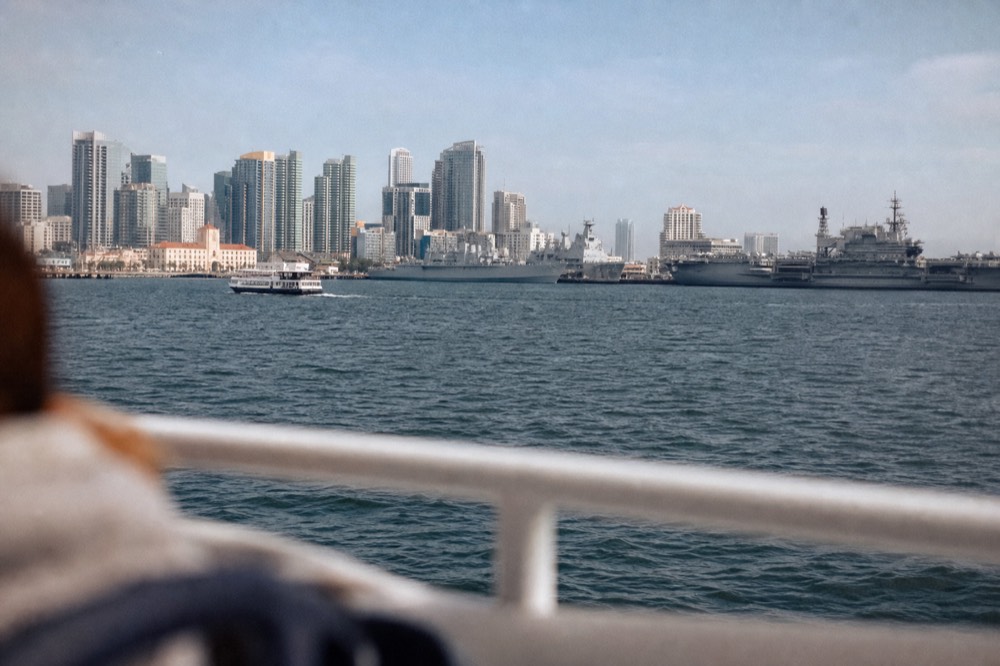
San Diego's coastal cloud is the thing visitors misjudge. May Gray and June Gloom are real, they are strongest from late May through the first half of June, and they can extend into July. They are not rain. They are a low grey lid that flattens photographs and drops the temperature on the water by more than people expect. The fix is a departure after the burn-off rather than a cancelled plan.
| When you sail | What the sky usually does | What it means on the route | Worth knowing |
|---|---|---|---|
| December to February | Clear and cool, sharp air | Excellent long-range views to Point Loma | Sunset falls about 4:53pm to 5:00pm, so late sailings are dark |
| March to April | Mixed, brightening | Good all-round loop conditions | Gray whale season is still running offshore |
| Late May to mid-June | Overcast mornings, marine layer | Flat light, skyline loses contrast | Book afternoon departures |
| July to August | Bright, warm, occasional morning cloud | Best warmth on the open deck | Sunset runs about 7:30pm to 7:48pm in August |
| September to November | Often the clearest of the year | Sharp light on both legs | Fewer crowds after Labor Day |
Sunset is the moving part. It swings from just before 5pm in January to nearly 7:50pm in August, which shifts the last useful photo departure by almost three hours across the year. Check the exact time for your date before you book an evening sailing, and if golden hour is the whole point, read when sunset actually falls rather than guessing.
One dated note for autumn visitors. Fleet Week San Diego runs from November 6 to 15 in 2026, and the free MeetTheFleet day on November 7 opens ship tours of littoral combat ships, amphibious assault ships and destroyers at Pier 13 on Naval Base San Diego between 9am and 3pm. That is a different waterfront from the Embarcadero, so it pairs with a bay sailing rather than competing with one.
On the water it is always cooler and windier than on the pier, in every month. Bring a layer you can put on and take off, and read what to wear on the water if you are packing light. If a November evening sailing is what you are after, sunset and evening cruises compares all five boats side by side, and each listing shows the real departure time and price for the date you pick.
Who should take the Coronado ferry instead of a harbor cruise?
Take the ferry if your goal is to reach Coronado and come back on your own schedule. Take the harbor cruise if your goal is to see the bay itself with someone explaining it. The ferry is a scheduled crossing rather than a guided tour, and it does not run the loop down the length of the bay.
These two products get confused constantly, and the confusion costs people either money or the thing they actually wanted. The ferry crosses to the Coronado Ferry Landing and drops you there. That is its job, and it does it cheaply and well. What it does not do is narrate the fleet, swing past the Midway at the right angle or take you under the bridge.
| Way onto the water | Time afloat | Narrated | What you get | Best for |
|---|---|---|---|---|
| One-hour harbor loop | 60 minutes | Yes | The north bay landmarks in a tight run | First-timers on a schedule |
| Two-hour full loop | 120 minutes | Yes | Both halves of the bay in one sailing | Anyone with a free half-day |
| Coronado ferry | A short crossing | No, it is transport | Arrival in Coronado, your own timing | Beach afternoons and bike days |
| SEAL amphibious tour | About 60 minutes afloat of a 100-minute trip | Yes | Downtown streets then a bay cruise in one vehicle | Kids, and anyone who likes a spectacle |
| Patriot jet boat | 30 minutes | No, it is a thrill ride | Spins, drift turns and spray | Teenagers and adrenaline |
Nobody at the pier ever does the other arithmetic, which is what a minute afloat costs on each of these boats. It reorders the list in a way that surprises people, because the cheapest ticket on the bay is rarely the cheapest hour.
| Boat | From price | Time on the water | Roughly per minute |
|---|---|---|---|
| Three-hour whale and dolphin run | from $34 | 180 minutes | $0.19 |
| Point Loma whale trip, small vessel | from $63 | 210 minutes | $0.30 |
| SEAL amphibious tour | from $55.59 | 105 minutes, about 60 of them afloat | $0.53 across the whole trip |
| Mission Bay sunset cruise | from $42 | 75 minutes | $0.56 |
| Harbor loop, one-hour leg | from $37 | 60 minutes | $0.62 |
| Coronado Cays gondola | from $74.37 | 50 minutes | $1.49 |
| Patriot jet boat | from $45 | 30 minutes | $1.50 |
Read that table for what it is. Per-minute cost flatters long offshore trips and punishes short ones, and neither the jet boat nor the gondola is sightseeing: one is a thrill ride, the other a private boat for up to six. What it does show is that the narrated loop sits mid-table while doing more explaining than anything above or below it. Prices move with the date, so treat those as starting points rather than quotes.
The amphibious option is the one worth a second look if you are travelling with children. It runs roughly forty minutes through downtown streets before splashing into the bay for about an hour on the water, holds 4.7 stars across 1,348 reviews, and it solves the "we already did a boat" objection because half of it is not a boat. The SEAL tour explained covers the route and the trade-offs in full. Every one of the San Diego Bay cruises on this site touches some part of this same water, and the harbor loop is simply the one that covers the most of it on a single ticket.
The route questions I get asked most at the pier
Five questions come up at the gangway more than all the others combined: whether the boat goes under the bridge, whether you really see the carrier, whether the sea lions are guaranteed, whether the long loop earns its price, and which rail to take. Short answers below, longer ones in the sections above.
Does the harbor cruise go under the Coronado Bridge?
Only the south bay leg does, which means the one-hour south bay option or the two-hour full loop. The one-hour north bay run stays in the Embarcadero half of the bay and never reaches the bridge.
Can you see the USS Midway from the boat?
Yes, and it is one of the best views of her anywhere. The north leg passes the carrier at water level, which shows the flight deck overhang and the scale in a way the shoreside walk cannot. Boarding her is a separate ticket from the museum.
Are the sea lions guaranteed on a harbor cruise?
No. They haul out on channel buoys and navigation markers, not on a fixed platform, so sightings vary by day and by tide. They turn up often enough that crews point out the likely buoys, and the north bay markers are the usual spot.
Is the two-hour loop worth the extra money over the one-hour?
For a first visit, usually yes, because the bridge and the working south bay are genuinely different scenery rather than more of the same. For a family with a young child, or a day where you also have a museum booked, the one-hour north bay leg delivers the famous landmarks without the long transits.
Which side of the boat should I stand on?
The rail nearest the shoreline the boat is following, then cross over on the return leg. Because departures can run north first or south first, ask a crew member at boarding which direction they are sailing, and set your position from that.
Book the route rather than the brand. Once you know which half of the bay you want, and whether you want it lit from the front or from behind, the rest of the decision takes about a minute. If you are still weighing it up, the straight verdict is in is the San Diego harbor cruise worth it?.