Most reviewed in this category
3-Hour Whale Watching Cruise
Three full hours past Mission Bay's jetty into open Pacific, long enough to reach the whales instead of glancing at them. Departs Quivira Basin.
Two migrations pass this coast every year, which is why San Diego can sell whale trips in January and July with a straight face. Three real listings run them: a year-round wildlife boat out of Point Loma, a three-hour tour from Mission Bay, and a small-group sailing catamaran. The season decides the species; this page decides the boat.
727 traveller reviews across the three boats, led by the Point Loma trip at 4.8 and the catamaran at a straight 5.0. Free cancellation on all three.
 Listings checked by David Ramirez, San Diego bay cruise specialist
Short answer
Go December to April for gray whales, which migrate close to shore, or mid-May to September for blue whales feeding further out; both windows follow NOAA's migration timing. Common dolphins show on most trips all year. The longer boats reach the whales with time to spare, which is why the three-hour trips beat anything shorter, and the catamaran trades a little range for silence under sail.
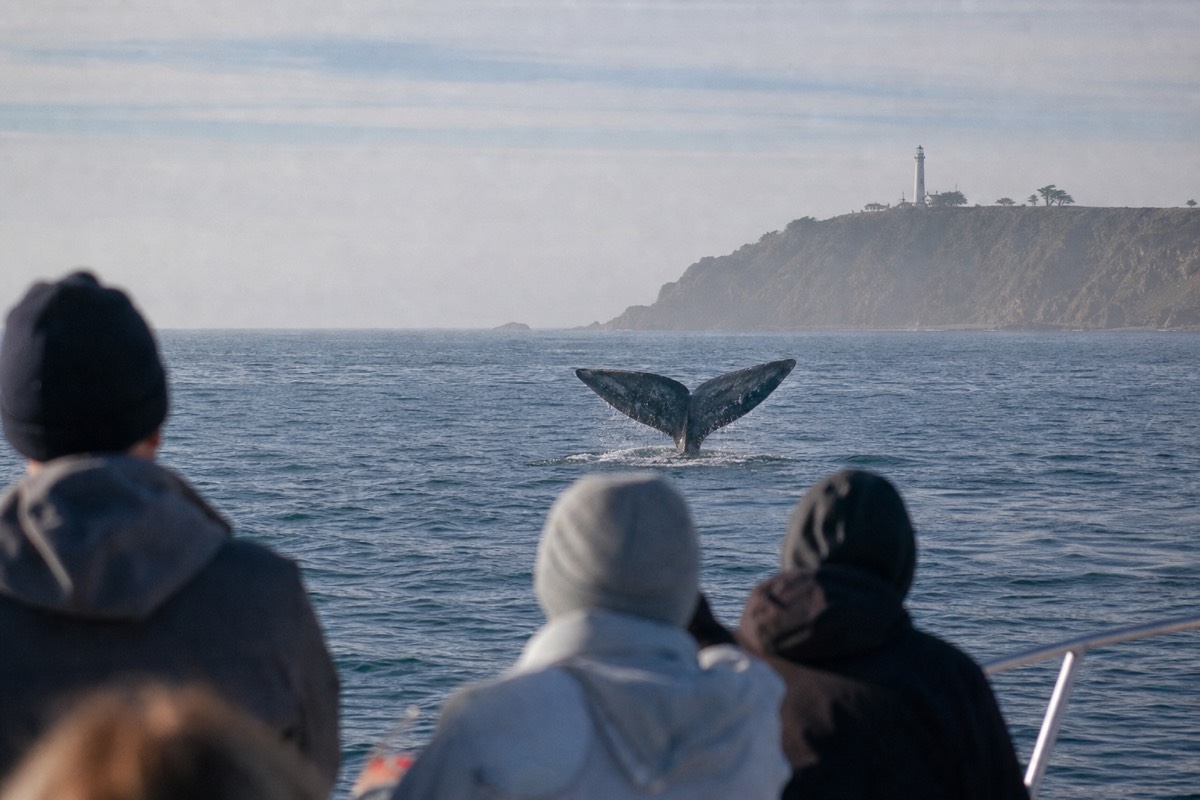
Whale trips are the only listings on this site that leave San Diego Bay behind entirely. The whales are outside: grays hug the kelp line past Point Loma on their 10,000-to-12,000-mile round trip between the Arctic and Baja, and blues work the feeding grounds offshore in summer. Clearing the point takes the first half hour, which is exactly why a three-hour ticket beats a shorter one: the extra time is whale time, not boat time.
The three boats split by temperament. The Point Loma trip is the naturalist's pick with the shortest run to open water. The Mission Bay boat gives you the full three hours and an indoor cabin for the gray-season chill. The catamaran carries a couple of dozen people under sail and gets quieter the further out it goes, which matters more than it sounds when something surfaces alongside.
Each rating below is the live listing's own figure, and whale-season demand moves the prices.
Most reviewed in this category
Three full hours past Mission Bay's jetty into open Pacific, long enough to reach the whales instead of glancing at them. Departs Quivira Basin.
A year-round wildlife run out of Point Loma with a small-boat feel: gray whales in winter, blues in summer, and common dolphin pods on most trips in between.
Whale watching under sail: a small-group catamaran out of Harbor Island that trades engine noise for wind, which matters when a whale surfaces close by.
Windows per NOAA's published migration timing for the eastern Pacific; what a given trip sees is still wildlife's call.
| Months | Species | How the sightings work |
|---|---|---|
| Mid-Dec to Feb | Gray whales, southbound | The peak. Grays pass close to shore heading for the Baja lagoons; spouts, flukes and the occasional breach on the kelp line. |
| Feb to Apr | Gray whales, northbound | The return leg, sometimes with calves swimming shallow and slow. Late-season trips can be quieter but closer. |
| Mid-May to Sep | Blue whales | The largest animal that has ever lived, feeding offshore. Sightings peak mid-July to mid-September; the run out is longer. |
| Oct to mid-Dec | Between migrations | The honest gap. Dolphins, sea lions and seabirds carry the trip; operators keep sailing because the wildlife never fully stops. |
| Where they leave | The Point Loma boat from the Emerson Street basin, the 3-hour trip from Quivira Basin in Mission Bay, the catamaran from Harbor Island. Check your ticket; these are three different docks. |
|---|---|
| Time of day | Morning water is usually calmer; afternoon light is better for photographs. If you are prone to seasickness, mornings are the kinder call. |
| What you wear | Two layers more than the beach forecast. Open ocean in gray season is winter boating, whatever the brochure photos suggest. |
| Seasickness | The swell starts at Point Loma, not at the dock. Take something before boarding rather than after; the back half of the boat moves least. |
| Cancellation | Free on all three listings, usually up to 24 hours out, and operators reschedule rough days rather than pound through them. |
January and February for gray whales close to shore; July and August for blue whales offshore. Mid-May and June are the swap-over, when a lucky trip can meet either. October to mid-December is the one quiet stretch, and dolphins run the whole calendar.
Morning for calmer water and steadier stomachs, afternoon for light. Sighting odds are close to even across the day; comfort is the real variable, and the gray-season chill is easier to dress for at noon.
The Point Loma trip for the shortest run to open water and a 4.8 across 283 reviews. The Mission Bay boat for the full three hours and an indoor cabin. The catamaran for small numbers and silence, rated 5.0 by the hundred-plus people who have reviewed it. There is no wrong pick here; there is a wrong month.
Realistically no. The harbor loops stay inside the bay, and the whales are outside Point Loma. Sea lions and dolphins inside the bay happen; a gray whale in the channel is a local-news event, not a plan. If whales are the point, book a whale boat in the right window.