San Diego Whale Watching Season 2026-2027: The Month-by-Month Guide
Two separate whale seasons, one quiet gap between them, and three very different boats. Here is which month gives you what, and which trip is worth booking in it.
 By David Ramirez, San Diego Bay cruise specialist & harbor experience guide
Short answer
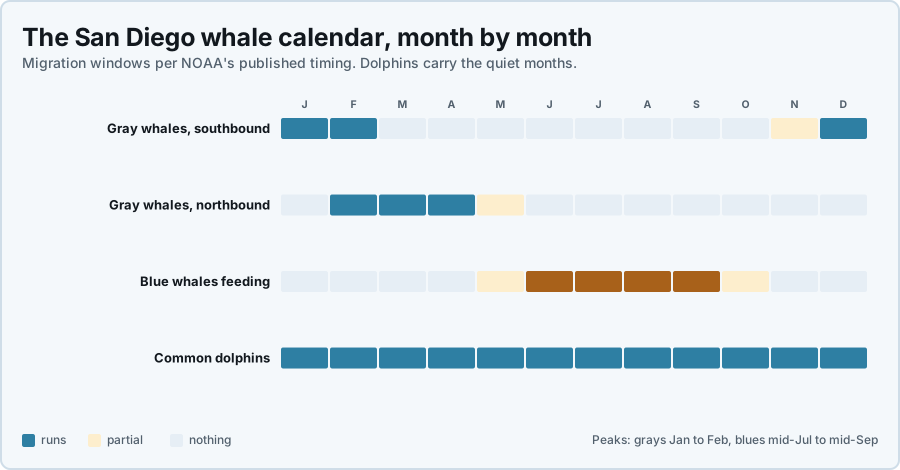
San Diego has two whale seasons rather than one. Gray whales pass on migration from December through April, peaking between mid-December and February. Blue whales sit offshore from mid-May into September, strongest from mid-July to mid-September. October and November are the thin months.
The calls change shape in December. From about the second week, the question stops being which harbor loop shows the most Navy ships and turns into whether the grays have started yet. I have been pointing visitors at the right dock in this city since 2015, and the first useful thing I can tell you is that San Diego does not have a whale season. It has two, run by different animals, on opposite sides of the calendar, with a quiet stretch between them that nobody puts on a poster.
When is whale watching season in San Diego?
San Diego runs two whale seasons. Gray whales pass on migration from December through April, with the southbound peak between mid-December and February and northbound animals into May. Blue whales are present offshore from mid-May through September, sometimes into October, peaking mid-July to mid-September. Dolphins and sea lions show up year round.
The two seasons work in opposite directions, which is why generic advice about "the best time" falls apart here. Gray whales are travelling. They move along the California coast between their Arctic feeding grounds and the calving lagoons of Baja California, and San Diego simply happens to be a good place to stand and watch them go past, twice, in either direction. The gray whale profile from NOAA Fisheries sets out the migration timing that every local operator schedules around.
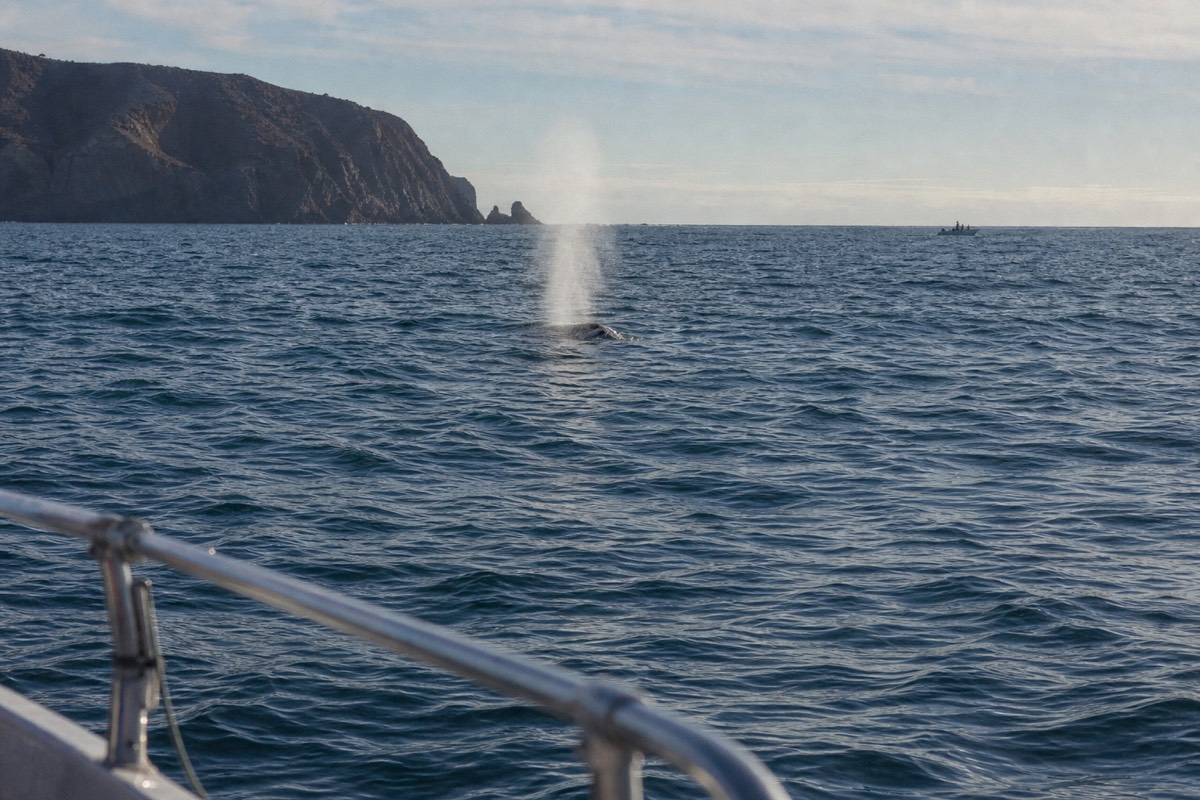
Blue whales are doing something else entirely. They are not commuting past the city, they are feeding, gathering offshore where the krill concentrates through summer. That means summer sightings tend to happen further out and involve fewer, larger animals rather than a steady procession. NOAA's blue whale page covers the species; the practical version is that a blue whale surfacing near a small boat is the single most impressive thing that happens on the water here, and it is a summer event.
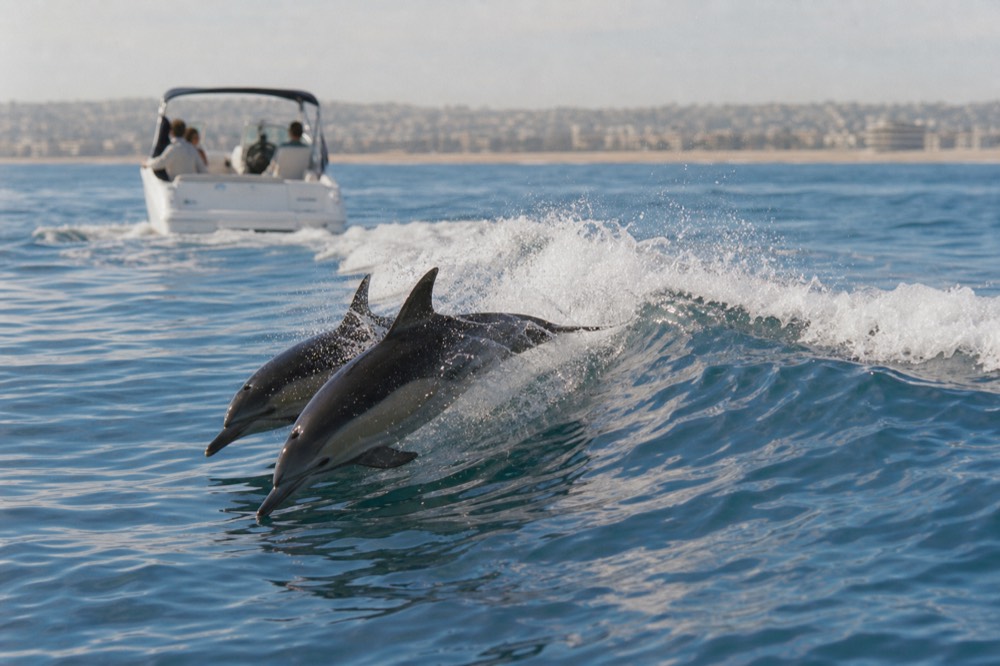
Between and beneath both of those, the resident wildlife carries on. Common dolphin pods are the most reliable sighting on any San Diego trip in any month, sea lions work the buoys and the bait, and the boats that run year round build their whole product around that fact. One Mission Bay operator's running season tally, as of mid-August 2026, stood at 316 whales against 22,952 dolphins across all its trips. That ratio is the honest shape of a San Diego whale season, and no poster prints it.
| What you might see | Window off San Diego | Peak stretch | Why the timing works that way |
|---|---|---|---|
| Gray whale, southbound | December to February | Mid-December to February | Travelling south along the coast toward the Baja calving lagoons |
| Gray whale, northbound | February to May | March into April | Returning north; the later part of the run includes mothers with calves |
| Blue whale | Mid-May to September, sometimes October | Mid-July to mid-September | Feeding offshore where summer krill concentrates |
| Common dolphin | Year round | No single peak | Resident pods, usually the first thing a boat finds |
| Sea lions and other marine life | Year round | No single peak | Buoys, bait and the water off the point |
Which month is the best for whale watching in San Diego?
January and February for gray whales, mid-July through mid-September for blue whales. Those two stretches sit at the peak of each migration, which is the only variable you can actually control. Everything after that is sea state and luck, and no honest operator will promise you a whale on a given morning.
If you already have your dates and cannot move them, the scorecard below tells you what you are working with. It is built from the migration windows rather than from any operator's marketing, so a few rows are deliberately unexciting. That is the point of it.
| Month | Headline species | Where it sits in the season | What to plan around |
|---|---|---|---|
| January | Gray whale | Southbound peak | Sunset lands close to 5pm, so afternoon departures are short on light |
| February | Gray whale | Southbound peak overlapping the first northbound animals | The busiest, most dependable stretch of the gray season |
| March | Gray whale | Northbound run | Cow and calf pairs travel later in the migration |
| April | Gray whale | Northbound, thinning through the month | The last dependable gray-whale month of the year |
| May | Changeover | Late grays early, first blues from mid-month | May Gray: the marine layer is at its strongest late in the month |
| June | Blue whale | Season opening | June Gloom: overcast mornings that usually burn off by afternoon |
| July | Blue whale | Peak begins around mid-month | The marine layer can hold into July on the water |
| August | Blue whale | Full peak | The longest evenings of the season, with sunset around 7:30 to 7:48pm |
| September | Blue whale | Peak runs to about mid-month | The last of the dependable blue-whale weeks |
| October | Thin | Blues may linger, grays have not arrived | The gap, covered below |
| November | Thin | Neither season is running | The gap, covered below |
| December | Gray whale | Southbound arrives, peak from about mid-month | The shortest afternoons of the year |
Visitors arriving in the shoulder weeks ask me to pick between, say, late April and early May. In that case the calendar is not really the deciding factor any more, the boat is. A shorter sailing trip with drinks on board justifies itself whether or not a whale turns up, while a three and a half hour search boat does not. That distinction runs through the rest of this guide, and it is also the reason the whale watching boats on this site are listed by length rather than by price. If your month lands inside either peak, open that page with your dates in hand: the three listings run from about $34 to $119, and each one shows what is actually available on the morning you want.
Is morning or afternoon better for whale watching in San Diego?
Neither half of the day comes with better odds, whatever you read elsewhere. What changes is the sky and the light. From late May into July the marine layer sits low over the water in the morning and usually burns off by afternoon. In December and January the opposite matters: sunset lands near five, so a late trip runs out of daylight.
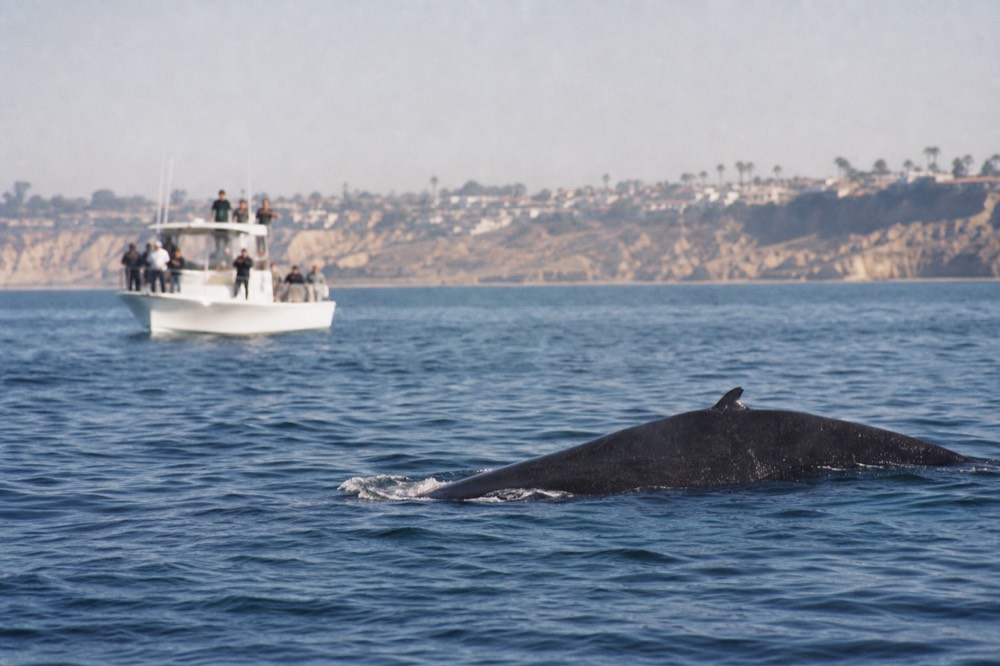
I get asked this more than any other whale question, and the honest answer disappoints people who want a trick. Whales do not keep office hours. What a morning or afternoon slot really decides is how comfortable you are and what your photographs look like, and in San Diego those two things are governed by the marine layer more than anything else.
Late May and the first half of June are when that layer is thickest, the local shorthand being May Gray and June Gloom. On those mornings the coastline vanishes into flat white and the water looks like pewter. It is atmospheric, and it is terrible for photographs. By early afternoon it has usually lifted. Run the logic backwards in midwinter and the afternoon becomes the weaker slot, because a 1pm departure on a three and a half hour trip is coming back into the harbor as the light goes. If you want the actual sunset time for your date, timeanddate's San Diego sun tables are the quickest check, and when sunset actually falls covers how much that shifts across the year.
| What changes | Morning departure | Afternoon departure |
|---|---|---|
| Sky, late May into July | Marine layer often sitting low over the water | Usually burned off, brighter decks |
| Winter light | Full daylight for the whole trip | In January sunset is near 5pm, so a late start eats the return leg |
| Deck temperature | Cooler, jacket weather in most months | Warmer, though still colder than shore |
| Rest of the day | Leaves your afternoon on the Embarcadero free | Runs into the evening, pairs badly with a dinner booking |
What does a three-hour whale watching trip actually deliver?
Time, mostly. The whales are not inside the bay, so every boat has to run out past Point Loma or the Mission Bay jetty before the search even starts. A longer listed duration means more of your trip is spent where the animals are. A typical three-hour trip commonly finds gray or blue whales depending on the season, plus dolphins and sea lions.
This is the part people misjudge when they book on price. The listed duration is not three hours of whales, it is three hours of everything: boarding, the run out, the search, and the run home. Cut thirty minutes off the total and you have not cut thirty minutes of transit, you have cut thirty minutes of search grid, which is the only part that decides whether you see anything. Here is what that grid produced on one real day: on August 16, 2026 a morning trip out of Mission Bay logged a single humpback and 200 short-beaked common dolphins, and the mid-day boat the same day logged 300 dolphins.
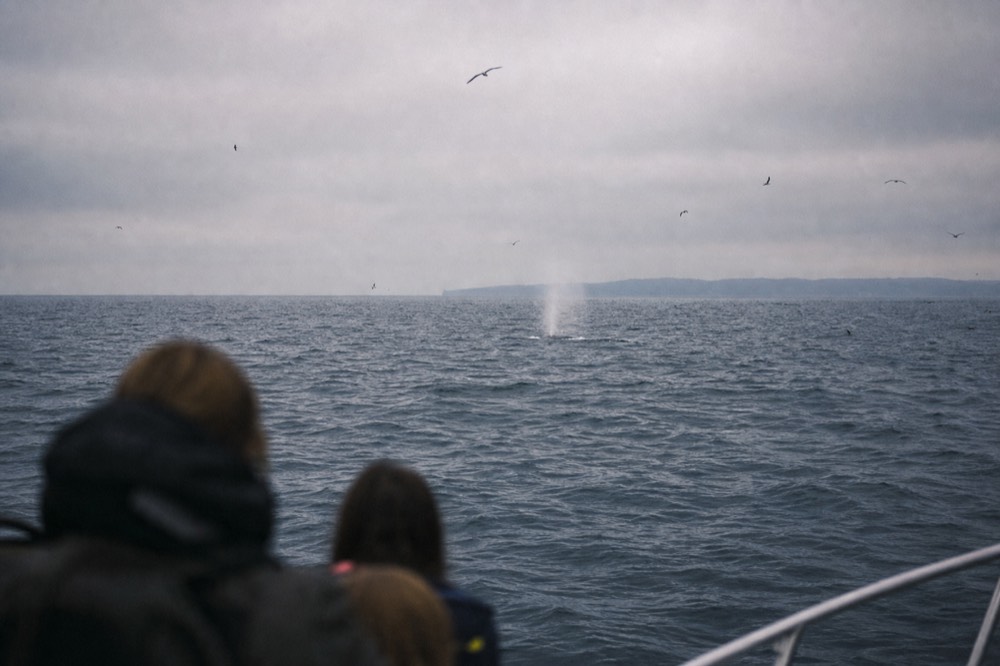
That is the case for the longest option on the list. The Wild Pacific boat runs three hours and thirty minutes out of Point Loma, closer to the open water than any other whale departure in the city, on a smaller vessel with a naturalist aboard. The Legacy trip runs a straight three hours out of Quivira Basin in Mission Bay and carries an indoor cabin, which matters more than people expect on a January morning. The sailing catamaran runs two and a half hours from Harbor Island, further inside the bay, so more of its clock goes to getting out and back.
None of the three guarantees a sighting, so treat every departure as a search rather than a viewing. What all three do carry is free cancellation up to 24 hours before departure, which is the real hedge: if the forecast turns ugly two days out, you are not stuck with the ticket. Whale trips are also the one category on this site that leaves the harbor entirely, which is why they sit slightly apart from the rest of the San Diego Bay cruises we compare.
What does whale watching in San Diego cost?
Three real numbers rather than a vague band: the three-hour Mission Bay boat starts from around $34, the three and a half hour Point Loma trip from around $63, and the small-group sailing catamaran from around $119. Trip length is not what sets the price: group size and what is included are. Parking is the cost most people forget, and it varies by which dock you are sailing from.
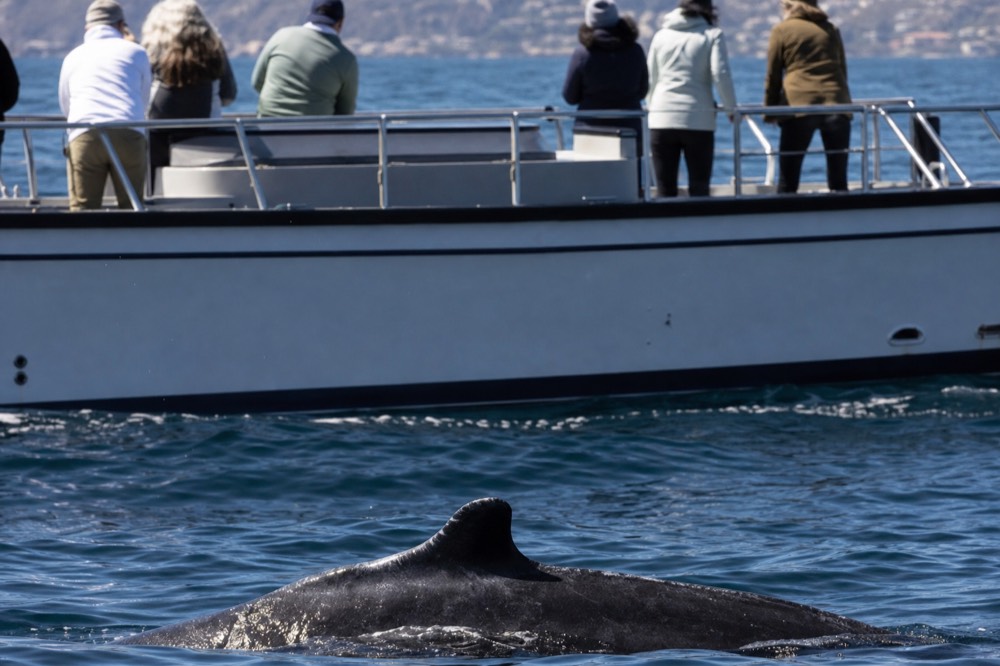
Prices on the live listings move with date and demand, so treat each of those as a starting point rather than a quote. What does not move much is the shape of the bill, and the table below is the version I give visitors who are budgeting a family of four rather than a couple.
| Line item | What the listings and operators show | What moves it |
|---|---|---|
| Adult ticket | From about $34, $63 and $119 depending on which of the three boats you take | Group size, what is included, the date |
| Cancellation | Free up to 24 hours before departure on all three listed boats | Nothing, it is standard across them |
| Trip length | 2.5, 3 or 3.5 hours depending on the operator | The vessel and the dock it leaves from, not what you pay |
| Parking | Port-run meters and pay stations plus nearby garages, rates posted on site | Which dock: Point Loma, Mission Bay and Harbor Island all park differently |
| On board | Drinks are included on the catamaran listing | Operator, not season |
The thing that surprises people is that the price and the search time run in opposite directions. The shortest trip is the most expensive one, because you are paying for a small group under sail with drinks rather than for minutes on the water. Divide the fare by the listed minutes and the gap is stark, which is the calculation worth doing before you sort anything by price.
| Boat | From price | Listed length | Roughly per minute afloat | What the money is actually buying |
|---|---|---|---|---|
| 3-Hour Whale Watching Cruise, Legacy | From $34 | 180 minutes | About 19 cents | The cheapest search time in the city, plus an indoor cabin |
| Wild Pacific Whale & Dolphin Watch | From $63 | 210 minutes | About 30 cents | The longest search of the three and a naturalist aboard |
| Whale Watching by Sailing Catamaran | From $119 | 150 minutes | About 79 cents | A small-group sail with drinks, whales in season |
Parking catches out first-timers who assume every cruise leaves from the Embarcadero. None of the three whale boats do. The Port of San Diego's parking page covers the downtown waterfront options, and where the boats leave from breaks down each dock in turn, including the ones out in Mission Bay.
Which boat fits which kind of visitor?
Take the Point Loma boat if the whale is the point of the day and you want the longest search. Take the Mission Bay boat if you want an indoor cabin and the largest review base. Take the sailing catamaran if you would enjoy the trip regardless, because a sail is worth the ticket on a blank day.
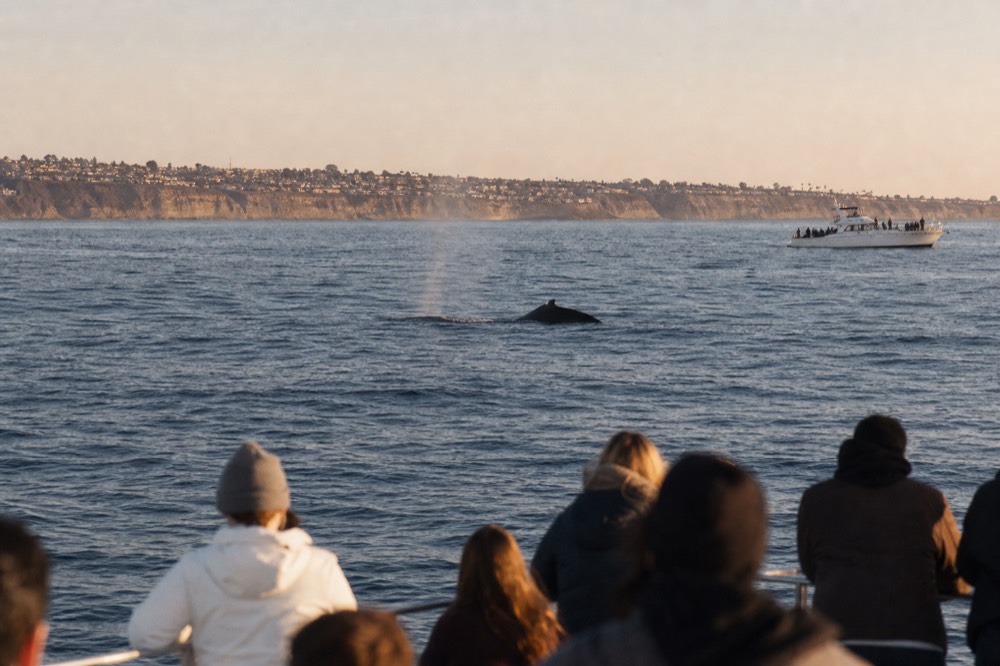
Three listings, three genuinely different products, and the ratings only tell you part of it. Read the review counts alongside the score: a 5.0 from 109 reviews and a 4.5 from 335 are not directly comparable, because the larger sample has simply had more chances to catch an off day.
| Boat | Rating and reviews | Listed length | Dock | What it is |
|---|---|---|---|---|
| Wild Pacific Whale & Dolphin Watch | 4.8 from 283 reviews | 3 hours 30 minutes | 2803 Emerson St, Point Loma | Smaller vessel, naturalist aboard, the longest search time on the list |
| 3-Hour Whale Watching Cruise, Legacy | 4.5 from 335 reviews | 3 hours | 1717 Quivira Rd, Mission Bay | Mid-size boat with an indoor cabin, the most reviewed of the three |
| Whale Watching by Sailing Catamaran | 5.0 from 109 reviews | 2 hours 30 minutes | 955 Harbor Island Dr | Small-group catamaran under sail, drinks included, the quietest deck |
Whatever you pick, put your actual travel date into the listing before you compare them, because the fares move and the gap between the cheapest and the dearest of the three is $85, wider than anything in the ratings. If your dates fall inside either peak and you want the version with the most water under it, that is the Point Loma trip: browse whale cruises compared and check the live price and availability for your date on the operator's official listing. The catamaran is the one I point couples toward, because sailing out of Harbor Island past the point is a decent afternoon even when the horizon stays empty. For a fuller head-to-head, Which whale watching tour is best in San Diego? runs the three side by side.
What happens to whale watching in October and November?
These are the two thin months. The blue whales have mostly moved on by the end of September, sometimes lingering into October, and the gray whale migration does not reach San Diego in numbers until about mid-December. Trips still run and dolphins are still out there, but the headline animal is missing.
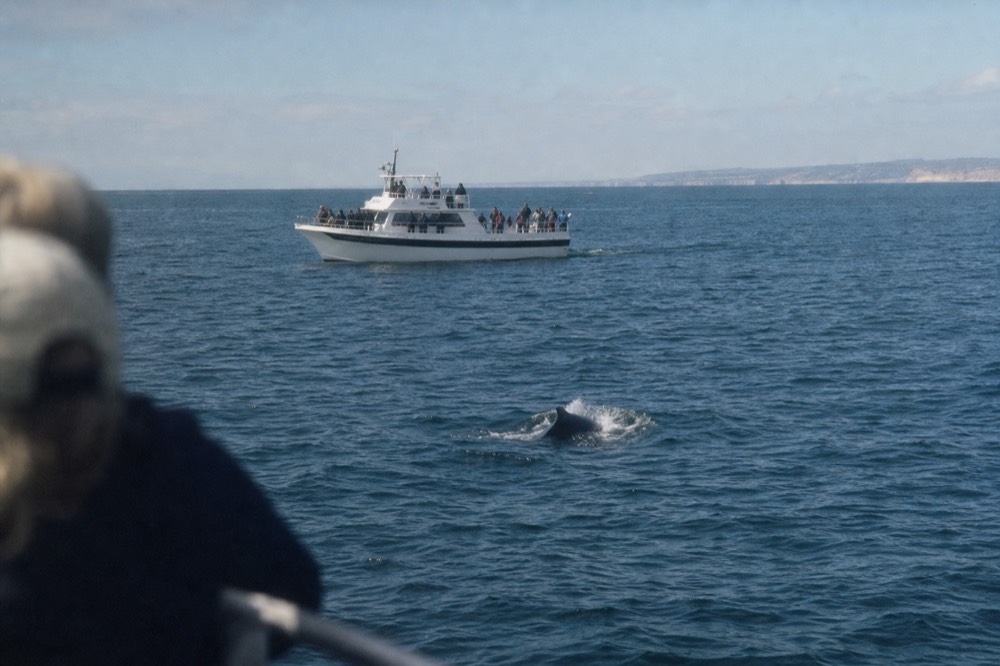
Nobody advertises this, so it is worth being blunt about it. If your trip lands in the second half of October or anywhere in November and the whale is the reason you are booking, your expectations should drop. What you are buying in that stretch is a boat ride with good odds on dolphins and sea lions, not a whale encounter.
There are better ways to spend that money in autumn, and I say so to visitors' faces. The narrated harbor loop past the Midway and the Star of India is at its best in clear October air, and the harbor cruise lineup covers the range from a one-hour loop up to the amphibious option. Evening light in autumn is genuinely good on the bay too, which is what makes sunset and evening sails the sensible autumn swap: that page lines up all five evening boats, from a $42 Mission Bay run to a $125 classic sail, and each listing shows live prices for the date you are actually here. If you still want the ocean itself, book the trip knowing what it is: a wildlife cruise, priced as one, with the whale as a bonus rather than the product.
Who should skip a San Diego whale trip?
Anyone who gets seasick and has not planned for it, families with toddlers facing three and a half hours offshore, and visitors who need a guaranteed sighting to feel the money was well spent. If your window is October or November and you specifically want whales, skip it and book something on the bay instead.
Open ocean past the point is not the flat water inside the harbor. Boats roll, and the mid-size vessels with indoor cabins handle that better than the small ones, which is one honest reason to choose the Mission Bay boat over the Point Loma boat if the swell worries you. Small children are the other common mismatch: three hours is a long time for a four-year-old with nothing to look at but water, and there is no bailing out halfway.
Short on time is the third case. If you have one free afternoon in San Diego and want to be on the water, a whale trip eats the whole block. A thirty-minute jet boat run or a one-hour narrated loop leaves you a day. The jet boat option covers the fast version, and if you want the water and the food in one booking, dinner and brunch cruises stay inside the bay where the water is calm.
What should you wear on a whale watching boat in San Diego?
Layers, always, and one more than you think. It is consistently cooler and windier on the water than on shore, in every month, and the marine layer that hangs over the coast from late May into July keeps the air damp as well as cold. Bring a windproof outer layer, closed shoes and sunglasses.
The single most common mistake I see at the docks is a family in shorts and flip-flops at 8am in June, because it is San Diego and the app said seventy degrees. Once the boat is past the point and making way, the apparent wind takes that number apart. Air temperatures stay mild here year round, but mild plus wind plus spray is a different proposition on an open deck for three hours.
What works: a base layer, something warm over it, and a windbreaker or shell on top that you can shed once the sun burns through. Closed shoes rather than sandals, because decks get wet. Sunglasses even on a grey morning, since the glare off flat overcast water is worse than direct sun. If you are prone to motion sickness, take whatever you use before you board rather than after you feel it. What to wear on the water goes through the seasons in more detail, including the evening sailings where the temperature drop is sharper.
Do you always see whales in San Diego?
No, and none of the three boats we list promises it. Inside the two peak windows, mid-December to February for grays and mid-July to mid-September for blues, the odds are at their best, but sightings depend on sea state and luck on the day. Dolphins are the far more reliable sighting and turn up year round.
What is the best month for whale watching in San Diego?
January and February for gray whales, August for blue whales. Those sit inside the peak stretch of each migration. February is the single strongest gray-whale month because the southbound run overlaps with the first animals heading back north.
How long are San Diego whale trips and where do they leave from?
The three listed boats run 2.5, 3 and 3.5 hours. They leave from three different places: Point Loma at 2803 Emerson St, Quivira Basin in Mission Bay at 1717 Quivira Rd, and Harbor Island at 955 Harbor Island Dr. None of them depart from the Embarcadero, so check your dock before you park.
Can I cancel if the forecast turns bad?
Yes. All three whale listings allow free cancellation up to 24 hours before departure for a full refund. That is the practical reason to book ahead in peak season rather than waiting for a clear forecast: you can hold the seat and release it if the weather goes wrong.
Is October or November worth booking for whales?
Not if the whale is the point. Blue whales have mostly moved on after September and grays do not arrive in numbers until about mid-December, so those two months are the thin part of the calendar. Book a harbor cruise or a sunset sail instead, and treat any whale as a bonus.